Landscape Lighting Planning Guide
Landscape Lighting You Can Plan Like a System, Not a Cart
Most landscape lighting pages sell fixtures one at a time and leave the math to you. A low voltage system lives or dies on that math: an undersized transformer trips, an undersized wire run leaves the far fixtures dim and orange. This page gives you the sizing numbers up front so the kit you build actually works, and since every product page shows live stock status, in-stock items ship within 24 hours, and shipping is free on every order, the whole system can be on site before the trencher shows up.
Transformer Sizing in Two Steps
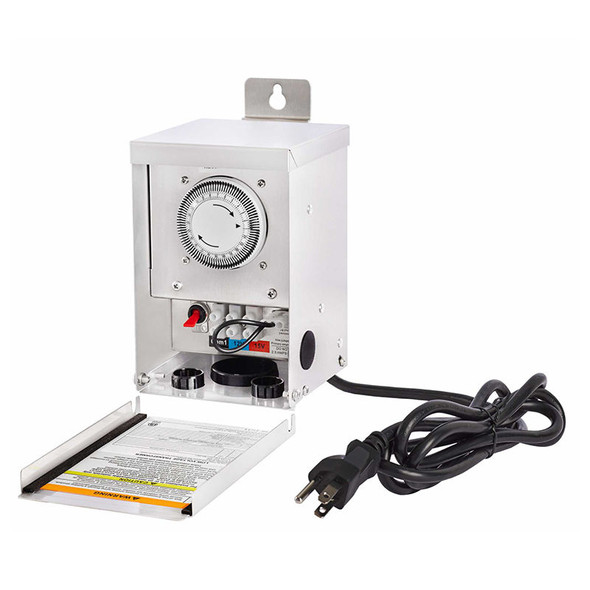
Add up the wattage of every fixture on the system, then add 25 percent headroom for future fixtures and voltage stability. Example: 12 path lights at 4W each (48W) plus 6 spot lights at 6W each (36W) totals 84W; with headroom you are at 105W, so a 150W transformer is the right unit. As a general rule, keep a transformer loaded between one third and 80 percent of its rating: enough load to run efficiently, enough margin to add a zone next season.
Wire Gauge and Run Length
Voltage drop is the silent killer of 12V landscape lighting systems. Use this planning table for a single home run, keeping drop to about 1.5V so LED fixtures stay in their happy range:
| Wire Gauge | Max One-Way Run at 60W Load | Max One-Way Run at 100W Load |
|---|
| 16 AWG | About 55 ft | About 30 ft |
| 14 AWG | About 85 ft | About 50 ft |
| 12 AWG | About 185 ft | About 110 ft |
| 10 AWG | About 295 ft | About 175 ft |
The underlying formula: voltage drop equals total watts on the run times one-way length in feet, divided by the cable constant (2,200 for 16 AWG, 3,500 for 14 AWG, 7,500 for 12 AWG, 11,920 for 10 AWG). Twelve gauge is the default for most residential runs. On long or heavily loaded runs, split fixtures across multiple home runs from the transformer rather than daisy-chaining everything on one line, and verify voltage at the farthest fixture with a meter at startup.
Build the System by Fixture Role
Landscape spot lights throw a tight beam up into trees and onto facades. Landscape path lights put soft downlight on walkways and drive edges without glare. LED well lights bury flush in grade for uplighting where a stake fixture would get hit by the mower. Landscape flood lights wash wider areas like turf, signage, and long fence lines. Transformers, low voltage wire, and connectors live in landscape lighting accessories, so the whole bill of materials comes from one order.
A workable starter layout for a typical front yard: 6 to 8 path lights along the walk, 2 to 4 spots on the facade or a specimen tree, and one well light at the entry, fed by a 150W transformer on two runs. Warm white in the 2700K to 3000K range reads as inviting on residential landscapes; save 4000K and up for commercial garden lights and security-oriented outdoor lighting.
Ordering for an Install Date
Live inventory on each product page means you know before checkout that the transformer, wire, and every fixture can arrive together. In-stock items ship within 24 hours with free shipping and no minimums, so adding two more landscape lights after walking the property costs nothing extra in freight. Planning a larger job? Run the layout past our lighting team through the QuickShipLights support portal before you order.
For the areas nearest the house, finish the perimeter with patio and porch lights, or browse the rest of residential lighting.