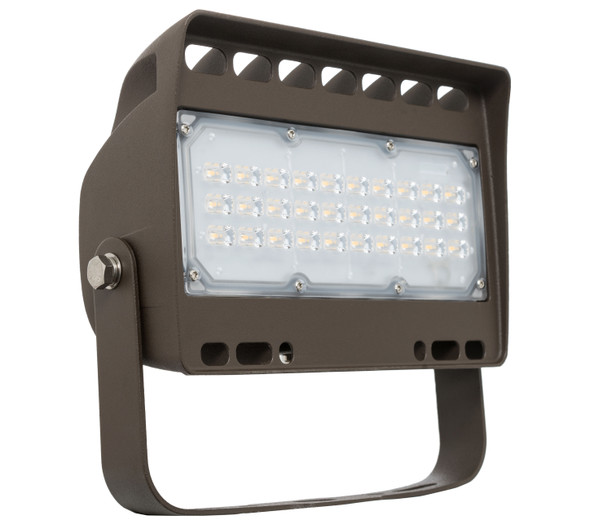
LED Flood Light Planning Guide
LED Flood Lights Sized by Mounting Height, Not Guesswork
Flood light returns almost always trace back to one mistake: buying wattage without knowing the mounting height. A fixture that is perfect at 12 feet disappears at 25. The coverage table below pairs wattage bands with the heights they actually serve, so the first order is the right order. Every product page shows live stock availability, in-stock fixtures ship within 24 hours, and shipping is free on every order.
Wattage to Coverage: Where Each Flood Light Band Works
Modern LED flood lights typically produce on the order of 130 to 150 lumens per watt. Use these bands as planning ranges and confirm exact photometrics on the product page spec sheet.
| Wattage Band | Approximate Lumens | Mounting Height | Typical Coverage |
|---|
| 15 to 30W | 2,000 to 4,500 | 8 to 12 ft | Entry accents, signs, small facades, landscape features |
| 50 to 100W | 6,500 to 15,000 | 12 to 20 ft | Building facades, yard security, small lots and drives |
| 150 to 240W | 20,000 to 36,000 | 20 to 30 ft | Larger parking areas, storage yards, courts and small fields |
| 300W and up | 40,000 and up | 30 ft and up | Athletic fields and high-mast work; compare stadium fixtures |
Beam spread finishes the math: narrow optics throw light farther from tall mounts, wide optics blanket area from short ones. Fixtures replacing metal halide typically cut connected load by half or more while holding the same footcandles on the ground, and DLC-listed models support utility rebate programs in many territories.
Knuckle, Yoke, or Slip Fitter: Get the Mount Right
| Mount Type | How It Attaches | Best For |
|---|
| Knuckle | Threaded adjustable joint on a junction box or arm | Wall and eave mounting, sign lighting, precise aiming |
| Yoke (trunnion) | U-bracket bolted flat to a surface | Flat roofs, walls, ground stakes; widest aiming range |
| Slip fitter | Clamps over a standard 2-3/8 in tenon | Pole tops and bullhorn brackets on area and sports poles |
The mount decides installation labor as much as the fixture does, so match it to the structure before ordering. Many models here offer the same head in more than one mount, and 120 to 277V input is standard on most commercial fixtures, with photocell and motion options for dusk-to-dawn and security duty. Outdoor flood lights should carry an IP65 or better wet location rating; that is the line between a fixture that shrugs off storms and one that fills with water.
When a Flood Light Is Not the Right Tool
Uniform illumination across a full parking lot is a pole-mounted area light job: see LED Parking Lot Lights. High-mast athletic projects belong in Stadium Lights, roadway and drive-lane lighting in Street Lights, and building-perimeter security in LED Wall Packs. The full outdoor family lives under Outdoor Area and Flood Lights.
Lighting a Site, Not Just a Wall?
Send the pole heights, mounting points, and the area you need covered. A lighting specialist will run the coverage math, recommend wattage and optics per position, and confirm live stock for the full fixture count: call 855-775-4533 or open a ticket at the QuickShipLights support portal.