
Commercial Restroom Lighting Issues Contractors Keep Correcting After Inspection
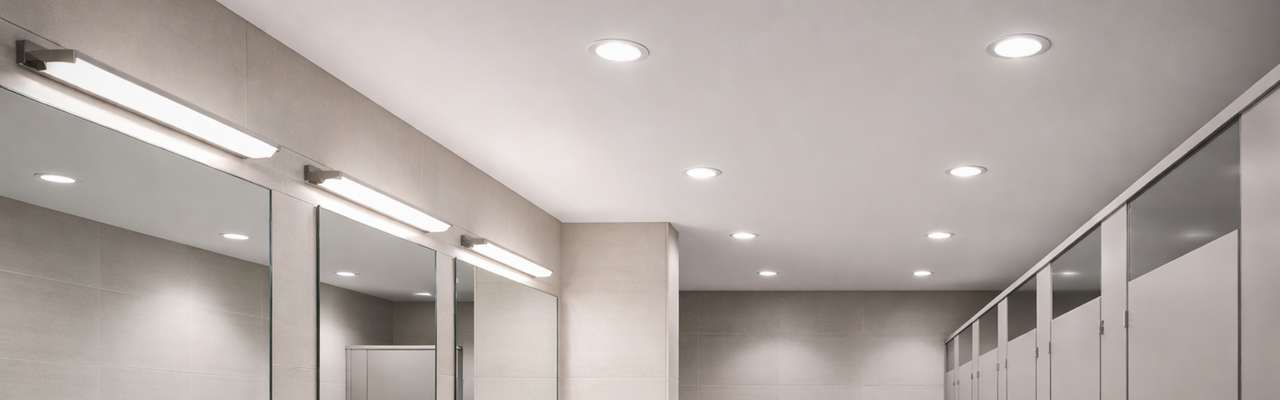
Commercial restroom lighting is a common source of inspection comments, owner-punch list items, and post-installation corrections. Small oversights in controls, fixture ratings, or layout coordination often lead to added labor, change orders, or rework after ceilings and finishes are already in place.
Many of these issues stem from missed code requirements, incomplete coordination with restroom layouts, or fixture selections that fail to withstand moisture, cleaning chemicals, or prolonged operating hours. Others are not strict code violations but still create problems during walk-throughs, commissioning, or ongoing use. Restroom lighting is often treated like any other interior space, even though it comes with tighter constraints and fewer opportunities to correct mistakes later.
This guide outlines the most common code-related risks and layout mistakes seen in commercial restrooms and explains practical fixes contractors can apply during planning or retrofit work. The goal is to reduce inspection comments, avoid callbacks, and deliver restroom lighting that performs reliably over the life of the installation.
Why Restroom Lighting Draws Inspection Attention
Commercial restrooms tend to draw more inspection attention than open areas because several enforceable requirements converge in a small space. Lighting in these rooms must comply with energy code controls, fixture listing requirements, and life-safety provisions where applicable. When any of these items are missed, the issue is immediately visible during inspection.
Inspectors primarily verify that required lighting controls are installed and function correctly, that fixtures are listed for the environment, and that emergency illumination is provided where the restroom is part of an egress path. Because restrooms are enclosed and highly defined, missing sensors, incorrect ratings, or misapplied emergency fixtures are harder to overlook than in larger spaces.
Problems arise when restroom lighting is treated as a late-stage detail rather than a coordinated part of the electrical and lighting design. A missed control note, an incorrect fixture rating, or a misunderstanding of emergency lighting requirements can lead to inspection comments or required corrections after finishes are complete. Planning these items early reduces the risk of rework and inspection delays.

Common Code Traps in Commercial Restroom Lighting
Most restroom lighting issues flagged during inspection come from a small set of repeated code mistakes. These problems are usually not complex, but they are easy to miss when restroom layouts are copied from older projects or rushed during design.
Energy Code Issues: Lighting Power and Controls
Overlighting is common in small restrooms. While many spaces still fall within allowable lighting power density limits, aggressive fixture spacing or decorative selections can create compliance issues, especially when paired with missing or misapplied controls in single-user or low-traffic restrooms.
Another issue is fixture efficacy. Luminaires that do not meet current efficiency requirements may be flagged even when light levels appear acceptable. Inspectors also note when restroom lighting is tied into adjacent spaces instead of being controlled separately, which conflicts with energy code intent and control zoning requirements.
Occupancy Sensor Placement and Settings
Occupancy sensors are required in most commercial restrooms, but placement is often treated as an afterthought. Sensors installed without accounting for stall partitions or doors fail to detect occupancy consistently.
Time-delay settings are another frequent issue. Lights that shut off too quickly generate complaints and often lead to post-install adjustments or inspection follow-ups when required controls are questioned. Line-of-sight obstructions reduce sensor effectiveness and typically require relocation if not addressed during planning.
Emergency and Egress Lighting Oversights
Emergency lighting is commonly missed in restroom layouts, especially in smaller spaces. Inspectors look for adequate illumination along egress paths during power loss, and insufficient coverage is a frequent correction item.
Battery-backed fixtures are often placed without considering mirrors, exits, or circulation paths. Poor placement leaves critical areas underlit during outages, creating safety concerns that are costly to fix after finishes are complete.
Code Requirements vs Recommended Design Practices
Not every restroom lighting issue is a code violation. Some items are enforced during inspection, while others affect performance, maintenance, and user experience but fall outside the inspector’s scope.
Commonly enforced during inspection:
-
Required lighting controls, including occupancy or vacancy sensors where mandated
-
Fixture listings and ratings for the environment, such as damp-location listings
-
Emergency illumination where the restroom is part of a required egress path
-
Compliance with applicable energy code control provisions
Recommended best practices that improve performance but are not typically enforced:
-
Mirror and sink lighting placement to reduce facial shadows
-
Stall lighting layout that improves uniformity and perceived safety
-
Glare control and light distribution for user comfort
-
Fixture selection based on durability, ease of cleaning, and maintenance access
Understanding this distinction helps contractors prioritize inspection-critical items while still delivering restrooms that perform well long after turnover.

Restroom Layout Mistakes That Create Glare, Shadows, and Dark Spots
Most restroom lighting problems come from fixture placement, not fixture choice. Poor layouts create glare, facial shadows, and dark areas that facility teams and users notice during walk-throughs.
Fixtures placed too far behind sinks cast shadows on faces and create mirror glare. In stalls, partitions often block light when spacing and mounting heights are not coordinated, leaving areas unevenly lit or visually uncomfortable.
Overlighting small restrooms to avoid dark spots causes glare and wasted energy, while underlighting creates safety and cleanliness concerns. Balanced spacing and proper optics provide better visibility than simply adding fixtures or increasing output.
Fixture Selection Mistakes in Commercial Restrooms
Fixture failures in restrooms usually stem from durability and maintenance being overlooked. Moisture, steam, and aggressive cleaning quickly expose weak housings, lenses, and finishes.
Fixtures not rated for damp locations are frequently flagged during inspection. Even when they pass, they fail early and often void warranties. Lens quality also matters. Low-grade lenses haze or discolor, reducing light output and making restrooms look poorly maintained.
Maintenance access is another common miss. Fixtures that require full removal to service drivers or controls increase labor time and restroom downtime. Standard components and accessible designs reduce long-term costs and service calls.
Practical Fixes Contractors Can Apply During Planning or Retrofit
Most restroom lighting issues can be solved with small adjustments made early. Shifting fixture locations to align with mirrors, sinks, and stall layouts eliminates glare and shadows without adding fixtures.
Controls work best when coordinated with partitions and traffic patterns. Proper sensor placement and time-delay settings prevent nuisance shutoffs and inspection issues.
Upgrading to sealed, durable fixtures with integrated controls and better optics often resolves multiple problems at once. These upgrades improve distribution, resist moisture, simplify maintenance, and support compliance without increasing fixture count.
Mistakes to Avoid on Commercial Restroom Lighting Projects
Ignoring sensor coverage inside stalls leads to nuisance shutoffs. Placing fixtures without accounting for mirrors creates glare and facial shadows. Using residential-grade fixtures accelerates failure and increases maintenance costs. Overlighting to avoid dark spots wastes energy and can trigger code issues, while missing emergency lighting compromises egress safety.
Addressing these risks during planning helps contractors avoid rework, pass inspections, and deliver restrooms that perform reliably long after turnover.
Get Help Planning Commercial Restroom Lighting
Planning restroom lighting doesn’t have to be complicated. Balancing code compliance, visual comfort, durability, and ease of maintenance helps restrooms pass inspections and perform reliably over time. Getting fixture selection and layout right early prevents rework, inspection delays, and ongoing maintenance issues.
RelightDepot’s team helps contractors and facility managers review existing restroom conditions, recommend the right fixtures, create a clear Bill of Materials, and plan controls for occupancy and energy compliance. For practical layout guidance or fixture recommendations, contact us directly.
Email support@relightdepot.com or call 888-548-6387 to connect with a lighting specialist.
Latest Blog Updates

Product Spotlight: Westgate SCX1.5 Series Seamless Linkable Linear Lighting System
What the SCX1.5 Series Is and Why It Matters The SCX1.5 Series is the newest evolution of Westgate...
Commercial Restroom Lighting Issues Contractors Keep Correcting After Inspection
Commercial restroom lighting is a common source of inspection comments, owner-punch list items, and...

7 Retail Lighting Decisions That Impact Sales, Energy Use, and Maintenance
Retail lighting directly impacts how products sell, how much energy a store consumes, and how often...

Save 12% Automatically on Lighting Orders Over $2,000
Large lighting projects can quickly become expensive and complicated when orders are placed in piece...

Lighting Basics: A Rule of Thumb to Estimate Total Lumens for Your Space
Underlighting can make a space feel dim and unsafe, while overlighting wastes energy and increases g...
Difference Between High Bay and Low Bay Lighting
Choosing between high bay and low bay lighting is one of the most common decisions in commercial and...